


YELLOW EYES
Teilestrasse 16, Berlin-Tempelhof, February 2021
Yellow Eyes grew out of a desire to show painting in spaces that do more than simply contain it. I was looking for rooms that could respond to the work - architecturally, physically, and atmospherically - and that would offer a productive tension rather than a neutral backdrop.
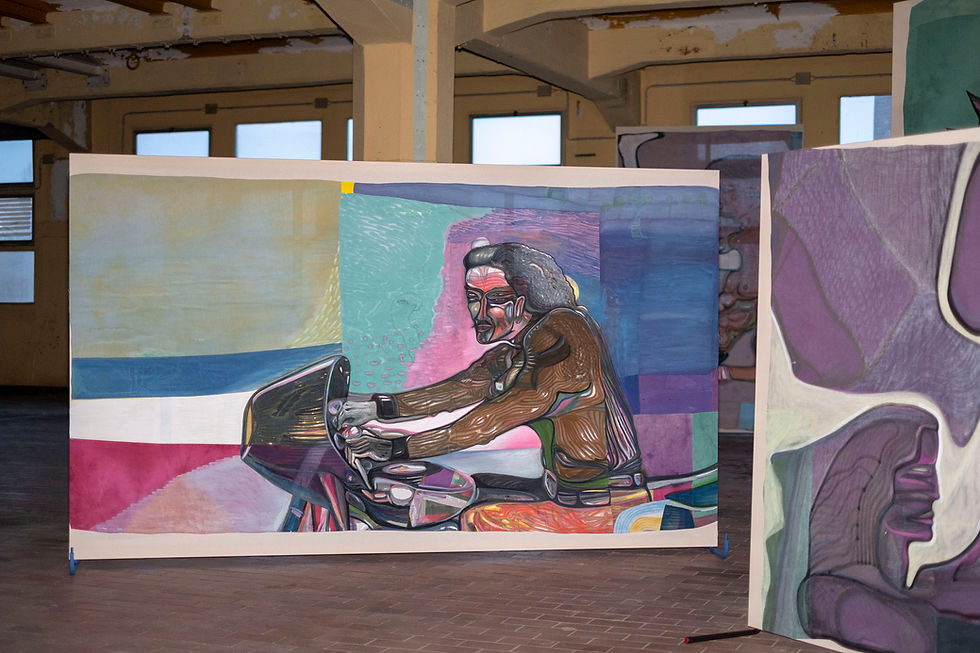
Instead of attaching the paintings permanently to the walls, I developed a system of freestanding painted structures. The works could stand in the room, be moved, turned, placed in relation to one another, and used to build temporary walls. In this way, the paintings became spatial elements in their own right: images, objects, partitions, and architectural gestures at the same time.
While their function recalls the historical folding screen, the project is not concerned with a nostalgic or classical use of that form. What interested me was its mobility: the possibility of positioning a painting in space without fixing it, and of allowing it to create changing thresholds, sightlines, and encounters. Each arrangement produced a different situation - a temporary constellation between painting, architecture, body, and camera.
The formal and spatial vocabulary of the project draws on several references: the ornamental intelligence of the Wiener Werkstatte, especially the work of Dagobert Peche; later decorative languages associated with Art Deco; and, in particular, the painted screens and immersive interiors of Robert Winthrop Chanler. Chanler's fantastical paravents and room environments dissolve the boundaries between painting, furniture, decoration, and architecture, allowing images to become active participants in the construction of space.
A second, very different point of departure came from photographs of The Rolling Stones recording Goats Head Soup at Dynamic Sounds Studio in Kingston, Jamaica, in 1972. In the small studio, large stretched canvases were used as improvised acoustic partitions between the musicians. The image is compressed: canvases standing freely in the room, bodies appearing between them, music being made inside a temporary architecture of fabric, support, and sound.
Installed inside the former chocolate factory at Teilestrasse 16 in Berlin-Tempelhof, a turn-of-the-century industrial building, Yellow Eyes explored painting as an architectural medium. Rather than occupying an existing room, the paintings entered into a direct relationship with the building and generated their own provisional spaces within it.
Teilestrasse 16, Berlin Tempelhof
Feb.2021